The Web Foundation announced the Web Index less than two weeks ago. The world’s first multi-dimensional measure of the Web’s impact on the world’s people and nations, the Web Index covers 61 developed and developing countries in its first edition and uses over 80 underlying indicators measuring topics such us communications infrastructure, policy, content availability, use of social networks, business use, freedom of speech and e-participation.
As part of one of the sub-indexes, called institutional framework, we looked at data related to press freedom and overall censorship, education, gender, and government openness in sharing data. We added a specific set of 14 indicators directly targeted at measuring open data worldwide ranging from whether the government has an open data initiative in place to broad existence of applications atop that data to wide use of open licenses.
We are introducing today that subset as the Open Data Index, and its results for the first year are as follows:
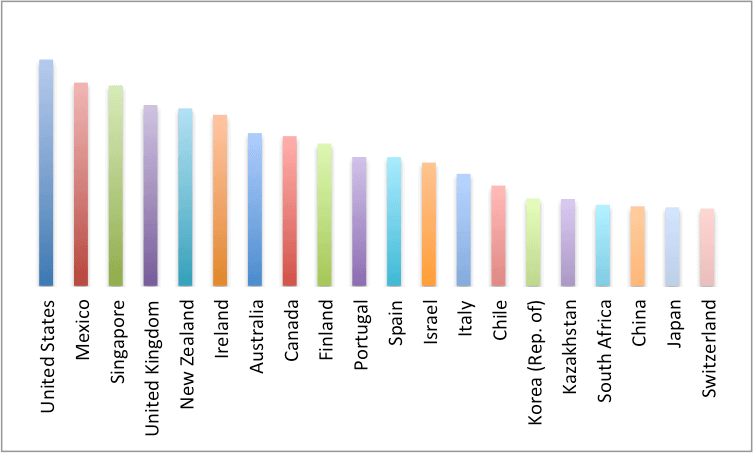
The highest ranking country is United States, in contrast to its overall Web Index performance where Sweden led the ranking. Interestingly, Sweden ranks #30 on the Open Data Index. There are other interesting examples, such as Mexico, escalating 20 positions from #22 to #2 here or Singapore, from #11 to #3.
The methodology behind the Web Index (and the Open Data Index) is available in full detail on the Web Index report (PDF), including all the questions related to Open Data, how they are integrated in the overall Web Index and the weight we gave them. All the data behind the Web Index is also available (including as Linked Data) under a CC0 license. The Open Data Index data is also available separately for download.
While constructing the Web Index, we learned that Open Data means different things to different people, and that views within the Open Data community are not always known, understood or shared outside of it. We plan to involve more experts on the next Index publication in 2013. Please, contact the Web Index team if you have comments, if you are interested in being involved or if you have conducted any research using the data and found any interesting things worth mentioning so we can learn from and amplify your findings.
Abbott Katz
September 23, 2012
A quick edit of the above text: the correct spelling isinterestinglyThanks,Abbott Katz
Reply
José M. Alonso
September 23, 2012
Fixed, thanks.
Reply
José M. Alonso
October 8, 2012
Added links to the raw data in spreadsheet format
Reply
Mashael
September 18, 2013
I am glad to find such big work like open data index because I am doing my PhD on the open data in Dublin (Ireland) but still in the first stage. It would be great if you can provide me with any information or material that can help me to write the literature review of OD. Kind regardsMashael Khayyat
Reply
Dillon Mann
September 27, 2013
Thanks Mashael - we have emailed you with a reading list. Good luck with your studies.
Reply
Tracey p. Lauriault
February 10, 2014
Greetings;I am looking for the "set of 14 indicators directly targeted at measuring open data worldwide" and "all the questions related to Open Data, how they are integrated in the overall Web Index " which seem to be unavailable from the links.SincerelyTracey
Reply
José M. Alonso
February 18, 2014
Hi Tracey, apologies for the broken link. You can find them at:http://thewebindex.org/2012/09/05-webindex-dataset.html#Q22
Reply
Mentor Memishi
October 13, 2014
Greetings, like Mashael, I am also glad to find such big work like open data index. I am doing my thesis on open government data (OGD), therefor it would be great if you can provide me with any information or material that can help me write the literature review of OGD.Kind regardsMentor Memishi
Reply
Mentor Memishi
October 13, 2014
Greetings, like Mashael, I am also glad to find such big work like open data index. I am doing my thesis on open government data (OGD), therefor it would be great if you can provide me with any information or material that can help me write the literature review of OGD.Best regardsMentor Memishi
Reply
Markus
March 4, 2015
Hi there,I was just reading the article in order to prepare for my bachelor thesis and noticed that, except for the "Linked Data" link, not one link is leading anywhere anymore. Could you maybe send me the background to the article, or provide me with some functioning links? (The link in the comment list is also broken at least for me)Have a nice dayM. KäppnerPs: I would like to fall in line with Mr Khayyat and ask if you could send me such a "reading list" :)
Reply
José M. Alonso
March 5, 2015
Thanks for your question and for noticing the issue with the links. The contents of previous editions of the WI (and the OD Index was a pull-out of it) were moved to http://legacy.thewebindex.org/More concretely, the files you're trying to access should be available at: http://legacy.thewebindex.org/?page_id=43It looks like something broke during recent migration process and they are not there yet either. Our webmaster is looking into this and they should be up again soon. We will then fix the links on this page, too.Sorry about the inconvenience.
Reply